Dispossession from home and the search for belonging
The Glass RoomDispossession from home and the search for belonging in The Glass Room is not only the loss of a building but the rupture of a life organized around it. The Landauer House passes from family home to confiscated property, Nazi research site, children’s gymnasium, and proposed museum. Across these transformations, the people connected to it struggle to distinguish legal ownership from lived attachment, and architectural preservation from the recovery of a home.
A home made through time and use
The house and the Landauer child grow alongside one another, but at different speeds. The child’s development arrives in intimate milestones—grasping, focusing her eyes, smiling, recognizing Liesel and then Viktor, raising herself, laughing—while the building takes shape through steel beams, poured concrete, and enclosed space. Delays over materials and labor stretch through summer and autumn. When the shell is finally complete in winter, there is no ceremony to mark it. The family approaches with apprehension: from outside, the building looks more like a warehouse than a home. Its rooms are still bare, lit by single bulbs, and smell of new cement and plaster. The contrast makes belonging something the family must create through inhabitation, rather than something guaranteed by architecture alone.
That domestic life is later recalled through precise details. In exile, Liesel tells Rainer that losing the house felt like losing a limb. She reconstructs it in her mind as a place she can still walk through: the terrace, the children’s toys, Ottilie’s and Martin’s rooms, and their bathroom with rubber ducks following their mother across the tiles. She remembers the route into the Glass Room as twelve steps to the curve and nine more down, where the space opens around her. This mental return preserves the house as lived experience, not simply as a design. The remembered rooms hold family routines and happiness that no change in legal title can erase.
Confiscation and the conversion of space
The decisive break comes in exile, when a letter from the family’s lawyers in Město arrives at the Landauer breakfast table. The mail is usually placed beside Viktor’s plate; among the business letters and occasional messages from home, the lawyers’ letter is set apart by its weight and gravity. Viktor tells Liesel that the government has confiscated the house. He calls the act expropriation, then names it plainly as theft. When Liesel asks why, Viktor answers that it is because he is Jewish. The dispossession is thus not an ordinary property dispute: state power strips the family of the home through antisemitic persecution, leaving their attachment without an effective legal remedy.
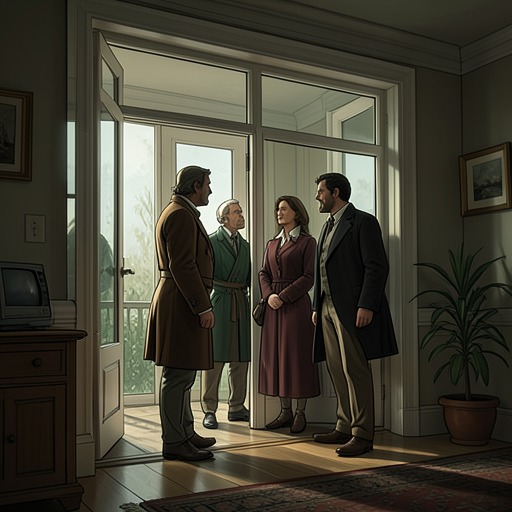
A conversation about what may happen to the building makes the injury concrete. A surveyor says the house may be demolished; a planning official explains that the Landauers no longer own it and that, as Jews, they will no longer win cases. When the children’s claim to their own rooms is raised, the answer is uncertain: their future depends on what the authorities decide to do with the building. The house’s rooms remain physically present, but the family’s right to occupy them has been severed. Even the prospect of demolition becomes a second loss. Liesel breaks down not only for the house on the hillside, but for her lost life and love and for the dislocated reality of exile. Her children have never seen her cry; Viktor appears helpless, while Katalin rises to comfort her.
Under Nazi occupation, the former home is remade into a biometric research centre. Upstairs rooms become offices, the kitchens are converted into a laboratory, and the basement is prepared for an X-ray machine. A photographic darkroom already left by the owners is put to use; curtains divide parts of the Glass Room, and the onyx wall becomes a backdrop beside weighing scales, a height-measuring stand, callipers, and other anthropometric equipment. The dining area is turned into a photographic studio, while Hollerith machines and files occupy the garage that once held the family’s cars. The Bösendorfer piano remains, incongruously, and is tuned by a Jewish piano tuner. The transformation is more than a change of function: a space designed for family life and openness is appropriated by a regime that classifies and administers people by race.
Exile and the house carried in memory
The empty house becomes another image of dispossession. With its owners gone, it is described as an enclosed box without human dimensions. Weather works on the building: rain strikes the terrace, snow settles and melts, and water enters the walls, freezing and expanding before thawing again. Paint and concrete flake, tiles loosen, and steel rusts. People walking along Blackfield Road speculate whether the owners went to Switzerland, Britain, or the United States, but daily survival leaves little room for sustained concern. In one storm, a plate-glass window in the Glass Room cracks diagonally, its line of reflection compared to a cataract. The building can endure as a structure while its original life remains absent and its fabric deteriorates.
Liesel’s recollection to Rainer answers that emptiness with an interior reconstruction. She does not remember the house as an abstract modernist object, but as a sequence of family spaces and movements. The remembered toys and bathroom fittings are as important as the Glass Room’s curve. Her account makes clear why a return to the property could not simply reverse exile: memory can restore an intimate sense of presence, but it cannot restore the lost years or make the displaced family’s life continuous again.
Public heritage and contested ownership
Decades later, the Landauer House has become a children’s physiotherapy gymnasium. A journalist presenting it as an architectural treasure acknowledges that the building serves sick children, while questioning whether such care must take place in a work of architectural importance. The article identifies the house as the work of Rainer von Abt, who designed what became his last European project before fleeing to the United States in 1938. It describes a living room of 230 square metres, with two walls of glass and a view across the city toward Špilas. The chrome pillars, onyx partition, and cream linoleum survive largely intact; the original plate glass was destroyed by a wartime bomb and replaced by smaller panes, though the mechanism that once lowered two window frames into the basement still works. Preservation, the article suggests, does not mean that the house has remained unchanged.
The same account credits caretaker Josef Laník and his sister with maintaining the building during the war and defending it during the fighting before handing it to Soviet forces. Laník’s version casts the transfer as a story of safeguarding a public asset and makes him a local official, while the journalist presents the house as a neglected architectural gem that should be opened to ordinary people. That public account sits uneasily beside the Landauers’ loss: the building can be praised as a shared treasure even as the circumstances of its confiscation recede from view. The difference between a preserved structure and a repaired injustice is central to the novel’s treatment of heritage.
The conflict returns when Město’s authorities invite Liesel to witness a handover. Her son Martin warns that accepting would amount to de facto recognition of the city’s legal ownership. The city’s representative, Veselý, argues that the country has changed and that the invitation belongs to a new effort to restore normal relations, acknowledge past errors, and open toward the West. Martin sees political calculation as well as a claim to the house; Veselý insists that the country’s present struggle is a matter of life and death. Neither position makes the property question disappear. The invitation offers the possibility of public acknowledgment, but attending might also lend legitimacy to the title created by confiscation.
Return, memory, and unresolved belonging
The invitation brings other histories of separation into the present. Liesel’s family had believed that Hana was dead after hearing that she had been arrested and deported in 1942, when they were in Cuba. In the confusion after the war, with Germans expelled and displaced people trying to return, they could not learn what had happened; the Iron Curtain then made the country seem to vanish from reach. The discovery that Hana is alive changes the meaning of return: the house is entangled not only with property and architectural history but also with lost relationships and the uncertainty of who survived.
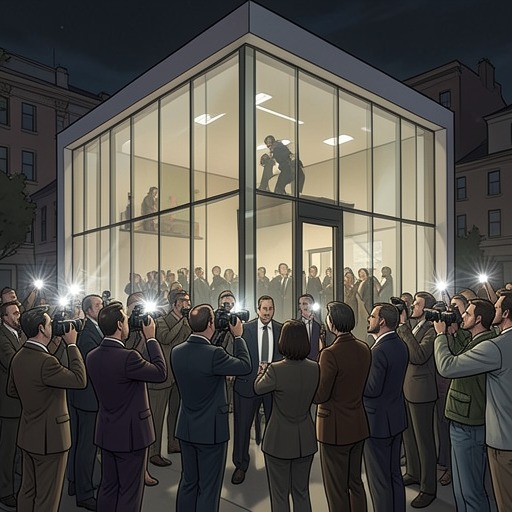
When Liesel is back in the Glass Room, the crowd makes the once-familiar space feel oppressive. She asks Hana to accompany her to the terrace for air. Laník’s presence disturbs her recollection of him as someone who used to watch her; Hana sees his rise to Party office as part of the larger political order. The building’s meaning cannot be settled by official speeches about its place in European architecture while people who lived through its changes remain in the room with their own memories. The present use of the house, its political history, and its past as a home press against one another.
The novel’s later recognition scene makes that tension explicit. In the house, Marie asks what happened to the Landauer family, and Milada answers that they left in 1938 and that the city now possesses the building as a museum. Yet the scene refuses to let the museum description contain the place: the Glass Room is presented as vibrant and alive, its piano chord reverberating with the remembered sounds of children and adults. Ottilie, now an American woman, insists that she is the child Ottilie who had been fixed in Marie’s distant memory. The Glass Room is described as a space of balance and reason, seemingly outside time, but the encounter fills it with the very losses and returns its official designation cannot account for. The house can be preserved and publicly claimed; belonging remains a more difficult question, grounded in memory, family, and histories of forced departure.